The madness, sadness and gladness of King Jesus
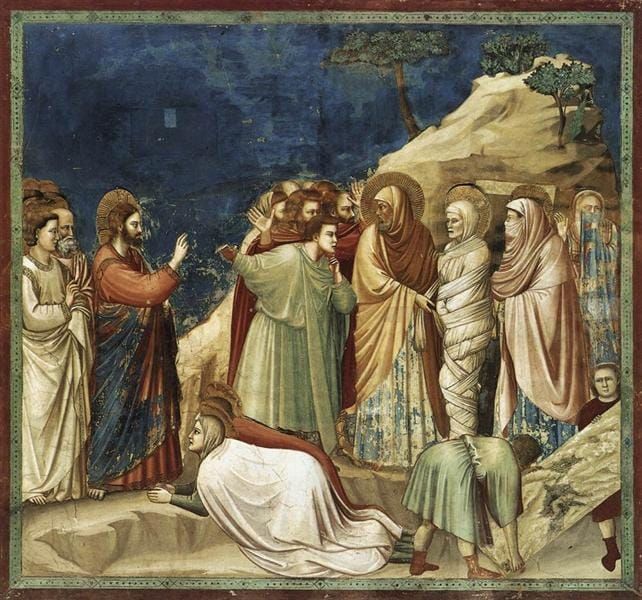
When Jesus saw her weeping and saw the other people wailing with her, a deep anger welled up within him, and he was deeply troubled. “Where have you put him?” he asked them.
They told him, “Lord, come and see.” Then Jesus wept. The people who were standing nearby said, “See how much he loved him!” But some said, “This man healed a blind man. Couldn’t he have kept Lazarus from dying?”
Jesus was still angry as he arrived at the tomb, a cave with a stone rolled across its entrance. “Roll the stone aside,” Jesus told them.
But Martha, the dead man’s sister, protested, “Lord, he has been dead for four days. The smell will be terrible.”
Jesus responded, “Didn’t I tell you that you would see God’s glory if you believe?” So they rolled the stone aside. Then Jesus looked up to heaven and said, “Father, thank you for hearing me. You always hear me, but I said it out loud for the sake of all these people standing here, so that they will believe you sent me.” Then Jesus shouted, “Lazarus, come out!” And the dead man came out, his hands and feet bound in graveclothes, his face wrapped in a headcloth. Jesus told them, “Unwrap him and let him go!”
John 11:33-44 (NLT)
Lazarus has died. His sisters, Mary and Martha, good friends of Jesus—whom we meet in Luke 10—are distraught. So too is the local community. We read in v19 many of the people from Bethany, Jerusalem, and the surrounding area had “come to console Martha and Mary in their loss”. No doubt our friend, and Lazarus’ friend, Simon the Leper was there too.
We’ve met Simon before in Mark 14, and will meet him again in John 12 where he hosts a feast for Jesus celebrating this very occasion (cf. John 12:2). It’s the same feast where Mary pours out the expensive perfume over Jesus’ feet. He’s also very likely to have been one who experienced the healing power of Jesus himself—either at this ostentatious event, or most probably, before! If Jesus was a close friend of the family, they’ve no doubt spent much time hanging out in Bethany!
Had we the honour of meeting Simon, I wonder how he would have recalled this event? We can only postulate and I believe he would have focused on the behaviours of Jesus, not his own or others. The behaviours of a man who was not only in touch with his Heavenly Father’s power and plan, but also with the emotions and raw reactions of the people around him.
Jesus was mad!
I don’t mean mad in the sense of delusionary. Some might consider his decision to stay away longer as a mad choice. We can discuss that another time! Here I mean anger. In verses 33 and 38 we read a sense of anger, or indignation encompassed Jesus. Many translations skate over this and say he was ‘deeply moved’ or ‘groaning within’.
Yet whatever the description, we see the anointed Messiah, the child of Eve promised in Genesis 3:15, troubled and motivated to change the situation. He sees the impact sin and death has on those whom he loves. He see’s that serpent of old, the Tempter and Adversary, the Father of Lies, ‘striking the heel’ of humankind. No doubt this drove him on towards the cross to complete his task of ‘bruising’ or ‘crushing’ that serpent’s head!
But here in the passage, this anger drove him to Lazarus’ tomb. It drove him to remove the stone from the doorway. It drove him to shout “Lazarus, come out!!”
Jesus was sad.
Emotions are human. And emotions are complex. Whilst our bibles might appear quite Stoical when read through our 21st century eyes, the reality of the situation in 1st century Judea would have been quite different. The village would have been raw with grief, anger, pain, and various other emotion. Even those who did not know Lazarus personally may well be swept up in the commotions.
And Jesus joins them in weeping (v35). We might well expect him to come in and proclaim their emotions null and void. Don’t be silly! He’s only sleeping! I am here to wake him up! But Jesus does not say that. Why would he?
Instead he weeps. He weeps with intense sadness at the pain and suffering the Serpent is causing. He weeps with his friends, joining them in their pain. He literally ‘holds space’ for their anguish. He feels what they are feeling without judgement or immediately seeking to ‘fix’ their view points. He is the true compassionate, empathetic man.
Jesus was glad!
Yet Jesus did not stay there. He was glad to help. He was glad to be able to use the power given him by his Heavenly Father to rescue these people, and their mutual friend Lazarus, from the power of the grave, from the pain the serpent was causing them.
We see Jesus at the stinking graveside calling out to his Father, “Father, thank you for hearing me. You always hear me, but I said it out loud for the sake of all these people standing here, so that they will believe you sent me.”
Here he calls for two love-soaked gifts: firstly, new physical life for Lazarus; and secondly, new spiritual life for the people. He as the anointed Messiah, about whom John has written these seven signs, he demonstrates his greatest claim, his most absolute qualification, his power to defeat DEATH, the final ‘level boss’.
And he was glad to do so. This is why he was here on earth.
And he was glad to fulfil his Messianic calling in its most ultimate act. In his own death. And his own resurrection. Again through the power of his Father, who ‘always hears him’ and brought him our from the grave triumphant over the serpent. Not killed with a sword. But killed through love.
And it’s through this act we have spiritual life. Lazarus came out with grave clothes on. He would need them again as the preachers often say about this passage! But Jesus left his neatly folded in the tomb. Lazarus would die again. Jesus is alive forever. And through that life Lazarus would indeed rise again from his second death (as Martha believed in v24) and so will we— ‘declare [agree] with [our] mouth, “Jesus is Lord,” and believe in [our] heart that God raised him from the dead, [we] will be saved’ (Romans 10:9)